
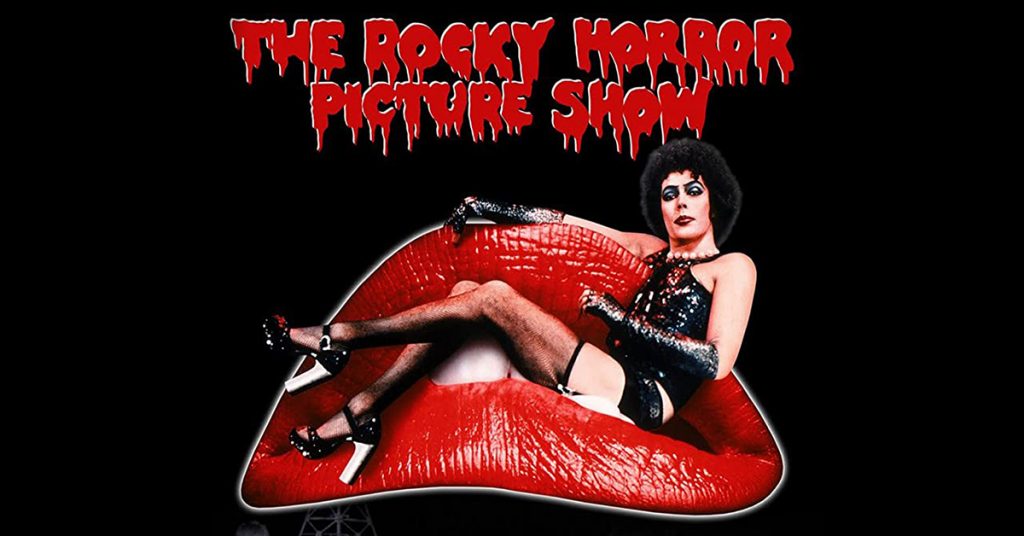
There are movies you watch, movies you love, and then there are movies that somehow give you permission to become a little more yourself.
For me, The Rocky Horror Picture Show is the latter.
Released in 1975, Rocky Horror is objectively bizarre. It’s a musical, a science-fiction parody, a horror comedy, a celebration of old B-movies, and a glitter-covered explosion of sex, camp, rock and roll, fishnets, and complete theatrical insanity.
Trying to neatly explain Rocky Horror almost defeats the purpose.
You’re supposed to experience it.
The story begins innocently enough. Brad and Janet are newly engaged, painfully conventional, and stranded after their car breaks down on a dark and stormy night. Looking for help, they stumble upon a castle filled with people who are anything but conventional.
And then the elevator comes down.
Out steps Dr. Frank-N-Furter.
Tim Curry’s entrance in Rocky Horror remains one of those moments in film that feels impossible to recreate. From the second those heels hit the floor, the entire movie belongs to him.
Frank is seductive, ridiculous, intimidating, funny, selfish, glamorous, dangerous, and completely uninterested in making himself easier for anyone else to understand.
For someone who has ever felt weird, that matters.
A Movie That Never Asked Permission
What struck me about Rocky Horror wasn’t simply that the characters were strange.
It was that the movie never apologized for them.
It didn’t introduce this world and then immediately reassure the audience that underneath the makeup, corsets, sexuality, and chaos, everyone was actually perfectly “normal.”
They weren’t.
That was the point.
There is something incredibly freeing about watching a movie where being different isn’t treated like a problem waiting to be solved.
Frank doesn’t quietly enter a room hoping nobody notices him.
He descends in an elevator wearing pearls, heels, makeup, and a corset and practically demands that you look.
There is no shrinking happening here.
And when you grow up feeling a little different yourself, seeing someone command a room precisely because they are different can stick with you.
But there was another part of Frank that stayed with me growing up, even before I completely understood why.
He made me feel something.
Not necessarily an attraction to Frank himself. It was the aura surrounding him.
There was something magnetic about the way he carried himself. The heels, the corset, the makeup, the movement, the swagger. Frank was openly sensual without treating that sensuality as something embarrassing or secret.
He knew people were looking.
He wanted them to look.
And instead of making himself smaller under that attention, he seemed to grow larger because of it.
As I got older, I started to understand what I had been responding to.
Confidence and sexuality can go hand in hand.
Frank was one of the first characters I remember seeing who made sexuality look less like something you possessed for somebody else and more like something that could belong completely to you.
It wasn’t simply about being desirable.
It was about feeling desirable.
There is a difference.
There was confidence in the way he moved, dressed, spoke, and occupied space. The sexuality came from that confidence rather than existing separately from it.
For a younger version of me who didn’t necessarily have the language to understand any of that yet, it was fascinating.
Frank took everything people are often taught to tone down, cover up, or feel embarrassed about and turned the volume all the way up.
And somehow, watching that helped me understand that confidence doesn’t always mean becoming tougher, quieter, or less emotional.
Sometimes confidence is allowing yourself to be seen.
Rocky Horror made weirdness feel powerful.
It made sensuality feel powerful.
And it suggested that neither needed to come with an apology.
Tim Curry Is the Movie
There are plenty of reasons Rocky Horror became a cult phenomenon, but it is difficult to imagine any version of this movie surviving for half a century without Tim Curry.
His performance shouldn’t work as well as it does.
Frank-N-Furter could easily become a caricature. Instead, Curry gives him an enormous personality while still allowing glimpses of vulnerability underneath all that confidence.
One minute he is hilarious. The next he is threatening. Then seductive. Then wounded.
Sometimes he manages all four within the same scene.
And that voice.
Songs like “Sweet Transvestite” don’t simply interrupt the movie because somebody decided it was time for another musical number. They are the movie. The soundtrack carries the same reckless energy as everything happening on screen.
Of course, Curry isn’t alone.
Susan Sarandon’s Janet undergoes one of the film’s most entertaining transformations, while Barry Bostwick’s Brad slowly watches the comfortable little world he understands collapse around him. Richard O’Brien’s Riff Raff is wonderfully unsettling, Patricia Quinn’s Magenta looks like she wandered out of the coolest nightmare imaginable, and Nell Campbell’s Columbia practically vibrates with energy.
Nobody seems interested in playing this material halfway.
Thank God.
Beautiful, Ridiculous Chaos
Visually, Rocky Horror exists somewhere between an old horror movie, a glam-rock concert, and a theater production that escaped the stage and started running through the building.
It looks theatrical because it is theatrical.
The sets don’t need to convince you that this is reality. The costumes certainly aren’t interested in realism. Everything is exaggerated.
The movie knows exactly how ridiculous it is.
That’s what makes the camp work.
There is a difference between a movie being silly because it failed to be serious and a movie gleefully throwing seriousness out the window.
Rocky Horror launches seriousness into orbit.
Then it puts on fishnets.
And No, Frank Isn’t Exactly a Hero
Watching the movie today also means acknowledging something important: Frank-N-Furter is not simply some flawless symbol of liberation.
He does terrible things.
He manipulates people. He crosses boundaries. He treats other characters horribly. His castle is hardly a model for healthy interpersonal communication.
This movie is messy.
That doesn’t erase what it represents.
If anything, trying to polish Rocky Horror into a clean little inspirational story would rob it of what makes it fascinating.
Its message isn’t necessarily, “Be exactly like Frank.”
Please don’t.
It’s closer to something much more interesting:
Maybe the rules you’ve been handed aren’t the only way to live.
Maybe there are other rooms.
Other people.
Other versions of yourself.
Maybe you’re allowed to explore them.
“Don’t Dream It, Be It”
There is a reason those words have survived beyond the movie.
Don’t dream it. Be it.
It’s theatrical and dramatic and perhaps a little ridiculous.
It’s also beautiful.
Because underneath the aliens, murder, sex, motorcycles, musical numbers, and whatever glorious substance seems to be floating through the air in that castle, Rocky Horror understands something very human.
People want permission to exist.
To experiment.
To dress differently.
To love differently.
To create.
To be loud.
To be strange.
To feel desirable without needing someone else to validate it.
To walk into a room without immediately calculating how much of themselves they need to hide.
For generations of people who didn’t quite recognize themselves in the neat, conventional characters Hollywood usually placed on screen, Rocky Horror offered something else.
A room full of weirdos.
And somehow, that room became home.
Fifty Years Later, We’re Still Doing the Time Warp
Perhaps the greatest review of The Rocky Horror Picture Show isn’t something a critic can write.
It’s what happened after the credits.
People kept showing up.
Midnight screenings transformed a movie into a ritual. Audiences dressed as the characters, shouted at the screen, danced, threw props, performed alongside the film, and passed the traditions down to people who weren’t even alive when it was released.
Most movies want an audience to sit quietly.
Rocky Horror accidentally created one that refuses to shut up.
I love that.
There is something perfectly fitting about a movie celebrating people who don’t follow the rules eventually developing an entire culture where the audience doesn’t follow the rules of watching movies either.
Half a century later, people are still putting on fishnets.
They’re still doing the Time Warp.
They’re still discovering Frank-N-Furter for the first time.
And somewhere, someone who has spent their life wondering if they’re a little too strange is watching that elevator descend.
They’re meeting Tim Curry’s Frank.
Maybe they don’t entirely understand what they’re feeling either.
Maybe what they’re responding to isn’t Frank himself, but that same impossible-to-ignore aura around him. The confidence. The sensuality. The freedom. The feeling of watching someone inhabit themselves so completely that everyone else in the room becomes part of their orbit.
Maybe they’ll recognize something in themselves that they don’t have words for yet.
I know I did.
That being weird doesn’t mean something went wrong.
That confidence can be sensual.
That feeling comfortable in yourself can be powerful.
And that maybe you don’t have to spend your whole life dreaming about the person you could be.
Maybe you can just be them.
MidSouth Noise Rating: 10/10 fishnet stockings.
Some movies age.
Some become classics.
The Rocky Horror Picture Show became a place people could belong.